
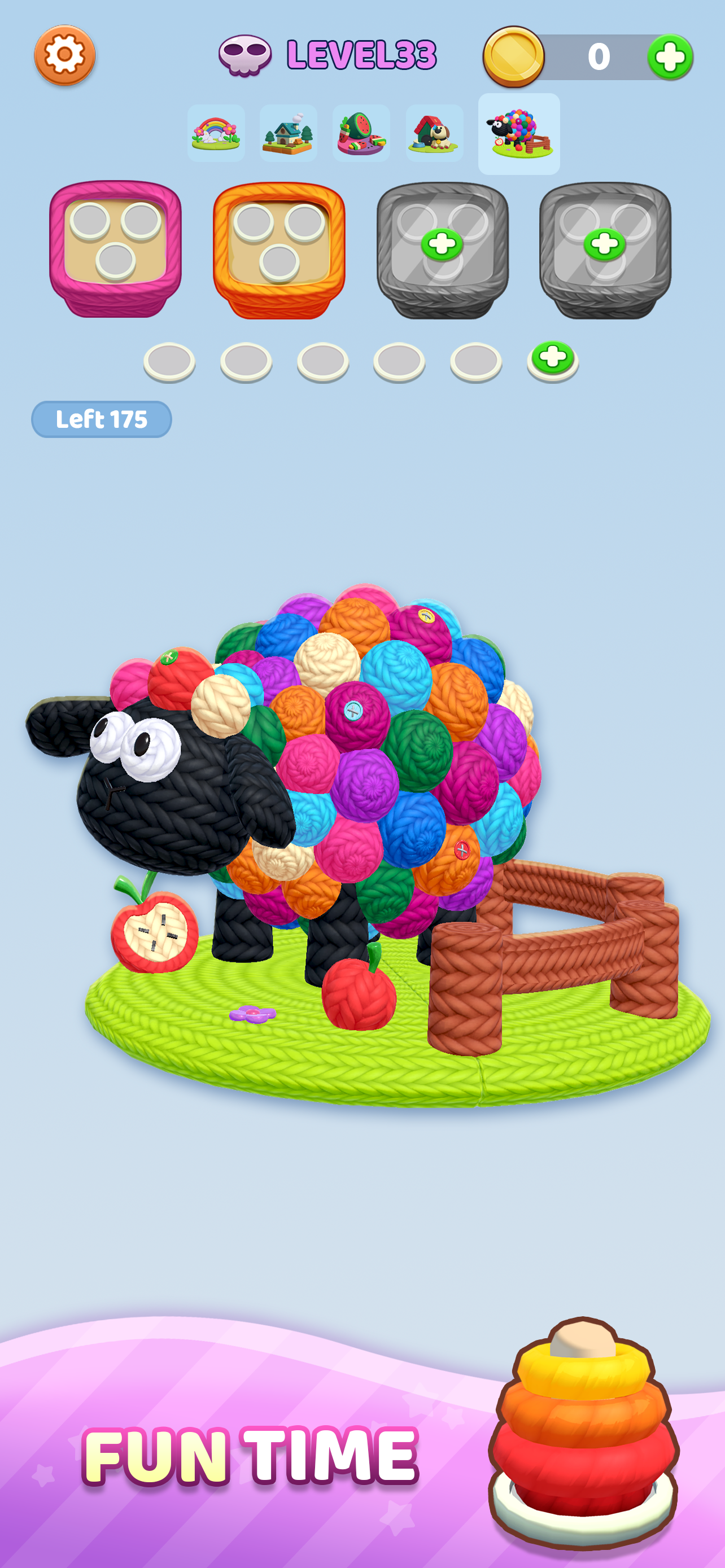
You've mastered the basics. You can beat easy levels without thinking. But now you're facing puzzles with 8+ colors and complex thread arrangements. It's time to level up your strategy.
Understanding Thread Dependencies
The key to advanced play is understanding thread dependencies. Every thread you need is either:
- Accessible: On top of an object, ready to collect
- Blocked: Hidden under other threads
- Dependent: Requires clearing other threads first
Before making any move, map out these dependencies mentally. Ask: "What do I need to clear to access the threads I want?"
The Dependency Chain Method
Here's a systematic approach for complex levels:
- Identify your target: Which color do you want to complete first?
- Find all threads of that color: Where are they located?
- Map the blockers: What threads are on top of your targets?
- Plan the chain: Work backwards from your goal
Example
Say you want to complete RED, but red threads are buried under BLUE and GREEN threads.
Your chain might be:
Complete GREEN → Clear BLUE → Access RED → Complete RED
Now you have a clear plan. Execute it step by step.
The "Pivot Color" Technique
Sometimes you can't complete your target color directly. You need a pivot color - a color you complete purely to unlock access to others.
Pivot colors are often:
- Colors with threads on top of multiple objects
- Colors blocking several other colors
- Colors with the fewest total threads
Completing a good pivot color can unlock 2-3 other colors at once.
Slot Management Mastery
Advanced players treat temporary slots as a strategic resource, not just overflow storage.
The "Slot Rotation" Technique
Instead of filling slots and waiting, actively rotate threads through them:
- Place a thread in slot 1
- Collect threads that let you empty slot 1
- Use slot 1 again for a different color
- Repeat
This keeps slots "flowing" rather than "stuck."
The "Color Pairing" Strategy
When you have limited slots, pair colors strategically:
- Put colors in slots that you can complete quickly
- Avoid putting colors in slots if their box is blocked
- Pair colors that appear together on objects
Reading the Puzzle
Expert players can "read" a puzzle and identify the solution path quickly. Here's what to look for:
Starting Points
- Single-color tops: Objects with only one color on top are good starting points
- Direct matches: Threads that can go straight to their box
- Isolated colors: Colors that appear on only one object
Danger Signs
- Color clusters: Multiple threads of the same color stacked together
- Deep nesting: Important colors buried 3+ layers deep
- Slot pressure: Many colors competing for few slots
The "Two-Phase" Approach
For very complex levels, divide your strategy into two phases:
Phase 1: Simplification
Focus on reducing complexity:
- Complete easy colors (few threads, accessible)
- Clear blocking threads
- Create "breathing room" in slots
Phase 2: Execution
With a simplified puzzle:
- Complete remaining colors in optimal order
- Use slots efficiently
- Finish strong
Practice Exercises
To master these strategies, try these exercises:
- Replay Level 100: Practice the dependency chain method
- Replay Level 150: Focus on identifying pivot colors
- Replay Level 200: Master slot rotation
- Replay Level 250: Apply the two-phase approach
Replaying levels you've already beaten lets you experiment without pressure.
Common Mistakes at Advanced Levels
- Tunnel vision: Focusing on one color while ignoring the bigger picture
- Impatience: Making moves before fully analyzing the puzzle
- Slot hoarding: Filling slots "just in case" instead of strategically
- Ignoring order: Completing colors in a suboptimal sequence
Final Tips
Advanced Yarn Fever is about thinking ahead. The best players see 5-10 moves into the future. They know which color they'll complete third before they finish the first.
This skill comes with practice. Keep playing, keep analyzing, and keep improving. You'll be conquering Level 400 before you know it!